Like Breath on Glass
Blenko Dalle de Verre (Pony Size 8 x 8) - Medium Blue
Blenko Dalle de Verre (Pony Size 8 x 8) - Medium Blue
Couldn't load pickup availability
Share
8" × 8" Cobalt / Royal Blue Dalle de Verre Glass Slabs
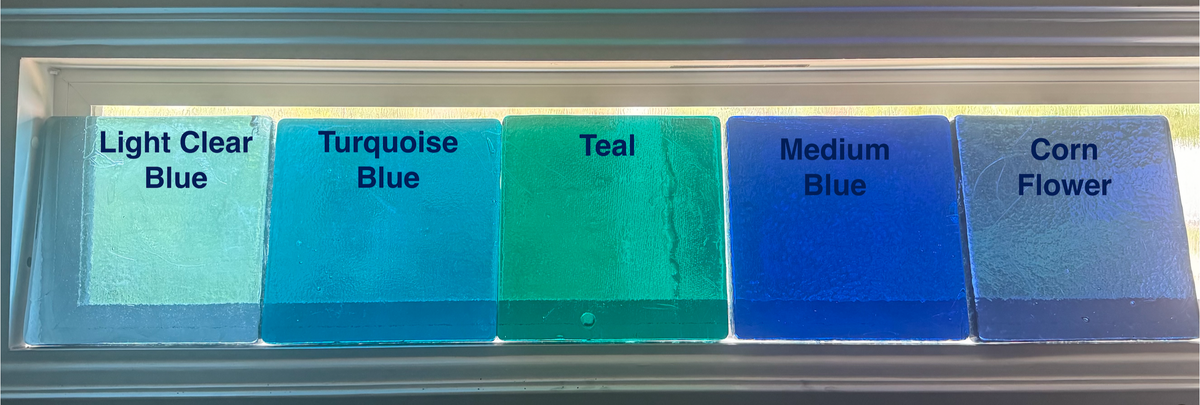
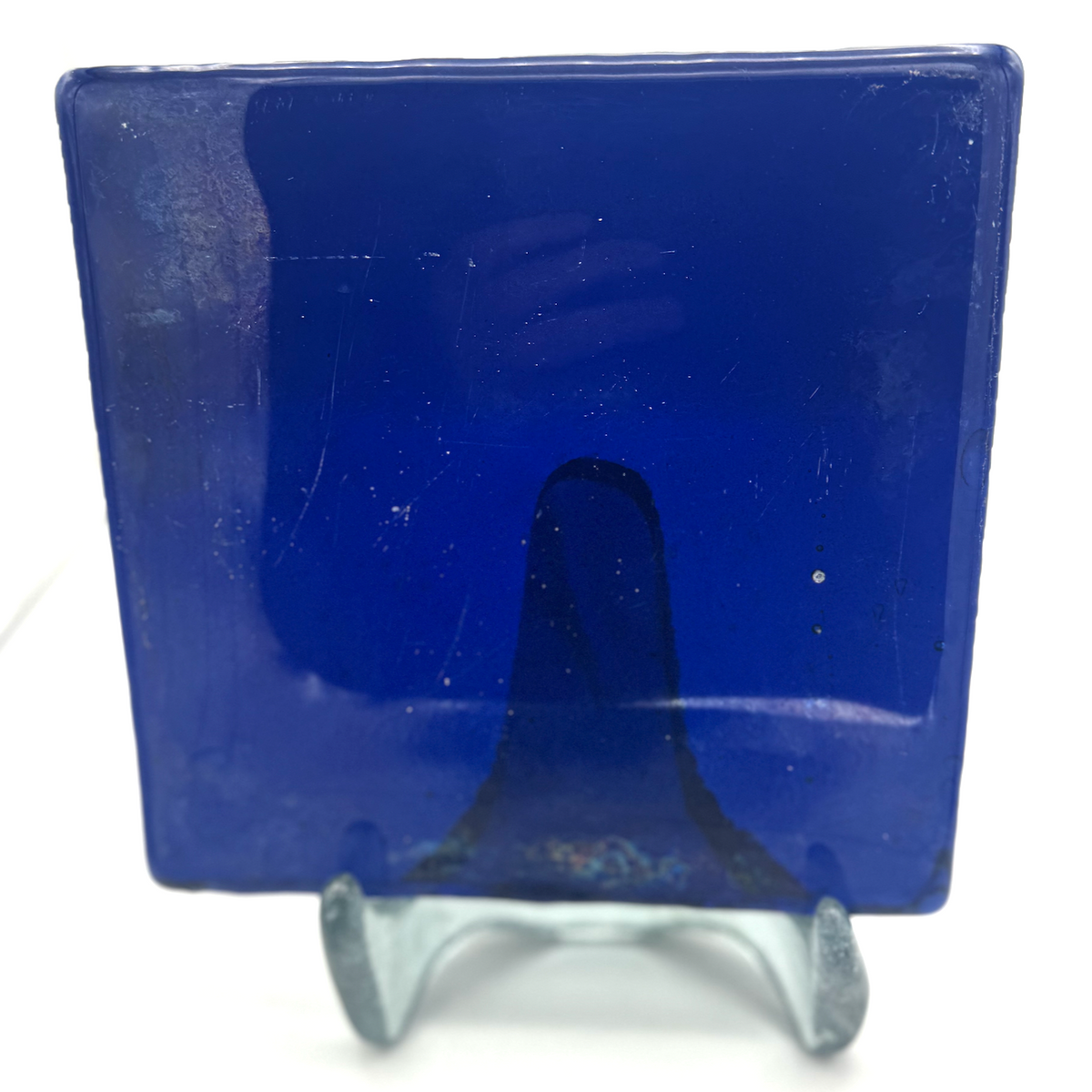
These 8" × 8" Dalle de Verre slabs have an exceptionally saturated cobalt-to-royal blue color. They reveal substantial changes in appearance depending on how they are illuminated.
When backlit, the depth of color is especially revealing: the glass becomes an almost electric sapphire blue, with a remarkably even luminous field. In natural backlighting, however, the lower portions appear to become much darker, due to background folliage producing a beautiful transition from brilliant blue to deep midnight/navy blue. When displaying these thick glass slabs the amount of light and background field matter enormously. The darker the slab the more direct light required.
Distinctive characteristics
-
Intense royal/cobalt blue: A strong, saturated blue that can become almost glowing when illuminated.
-
Excellent translucency: Light penetrates deeply into the slab rather than simply passing across its surface.
-
Dark-to-light tonal range: The same piece can appear almost navy in one lighting condition and brilliant cobalt in another.
-
Subtle internal texture: Small bubbles, inclusions and variations visible in the photographs give the otherwise strong blue field some organic character.
-
Softly rounded edges: The substantial edges emphasize that these are thick architectural glass slabs rather than ordinary stained-glass sheet.
-
Beautiful edge illumination: Light entering through the sides produces an especially vivid blue glow.
-
Strong graphic potential: Because the color is so powerful, these slabs can serve as large areas of uninterrupted color within a more complex composition.
How an artist could create art with these slabs
Make a luminous abstract composition
These slabs are ideal for an abstract artwork built around color, light and geometry.
An artist could cut several 8" × 8" slabs into:
-
triangles
-
sweeping curves
-
narrow strips
-
irregular organic shapes
-
geometric blocks
-
large architectural forms
The pieces could then be combined with lighter blues, turquoise, clear glass or contrasting warm colors.
The intense blue would naturally become the visual anchor of the composition.
Create a contemporary Dalle de Verre panel
The traditional approach would be to cut the slab into individual pieces, arrange them according to a full-size design, and set them into an appropriate epoxy or cement matrix. Dalle de Verre is particularly well suited to bold, simplified designs because the thick glass and substantial matrix lines favor strong shapes rather than extremely fine detail. Surrounding the glass with dark or black epoxy focuses the eye and reduces light pollution surrounding the glass.
For example, an artist could create:
A stylized ocean scene with the cobalt glass forming deep water, turquoise pieces representing shallows, and clear or pale blue pieces representing foam and reflections.
Exploit the blue for underwater imagery
This particular color would be extraordinary for an underwater-themed artwork.
The artist could use the dark portions of the glass for:
-
deep ocean
-
underwater caves
-
shadows
-
silhouettes
-
deep currents
while using the illuminated cobalt areas for:
-
sunlight penetrating water
-
surface reflections
-
wave patterns
-
rays of light
The result could look less like a painted picture and more like actual captured light beneath the water.
Facet the glass to create "sparkling" blue light
One of the most exciting possibilities is faceting.
Dalle de Verre artists traditionally chip or facet portions of thick glass to create angled surfaces. Those facets redirect and refract incoming light, producing the characteristic jewel-like sparkle associated with the technique.
An artist could deliberately facet only certain areas, essentially drawing with light.
Create a backlit wall sculpture
These slabs don't necessarily have to be cut up.
A single 8" × 8" slab could be displayed as a minimalist contemporary glass sculpture with LED illumination behind it.
The LED photograph demonstrates how dramatically the blue responds to artificial illumination. A concealed LED panel or light box could transform the slab into a glowing blue architectural object.
This could work particularly well in:
-
contemporary interiors
-
galleries
-
restaurants
-
entryways
-
meditation spaces
-
architectural installations
Combine them with contrasting colors
The saturated blue provides an excellent foundation for a broader palette.
Blue + turquoise
Creates an oceanic, tropical feeling.
Blue + clear glass
Produces a sophisticated, icy composition.
Blue + violet
Creates a mysterious, nocturnal palette.
Blue + amber/gold
Creates dramatic complementary contrast.
Blue + white/opalescent glass
Could suggest clouds, waves, ice or moonlight.
Blue + black
Creates an exceptionally dramatic modern composition.
A particularly interesting artistic approach
For these specific slabs, I would consider creating a large abstract "Deep Water" panel.
The artist could cut the 8" × 8" slabs into large sweeping forms rather than small mosaic pieces. Dark blue pieces would form the lower portion of the composition, while brighter cobalt pieces rise toward the top. Selected edges could be faceted to create concentrated flashes of light.
Small areas of turquoise and clear glass could then be inserted between the blue forms.
With LED illumination behind the finished panel, the composition could change dramatically depending upon viewing angle and light intensity.
The result would combine sculpture, mosaic, architecture and illumination—and would allow the inherent physical properties of the Dalle de Verre to become part of the artwork rather than simply serving as colored material.
Artistic character
Overall, I would describe these slabs as deeply saturated royal/cobalt-blue architectural glass with exceptional luminous potential. They are particularly valuable to an artist because the color has enough intensity to stand on its own, while the considerable thickness gives it a depth and dimensionality that thin stained glass cannot easily reproduce.
They could be used as raw slabs, cut architectural elements, faceted mosaic pieces, illuminated sculpture, or components of a large Dalle de Verre installation. The LED photograph in particular shows why this blue would be a powerful choice for an artist interested in making light itself part of the artwork