Like Breath on Glass
Blenko Dalle de Verre - Gold / Dark Amber
Blenko Dalle de Verre - Gold / Dark Amber
Couldn't load pickup availability
Share
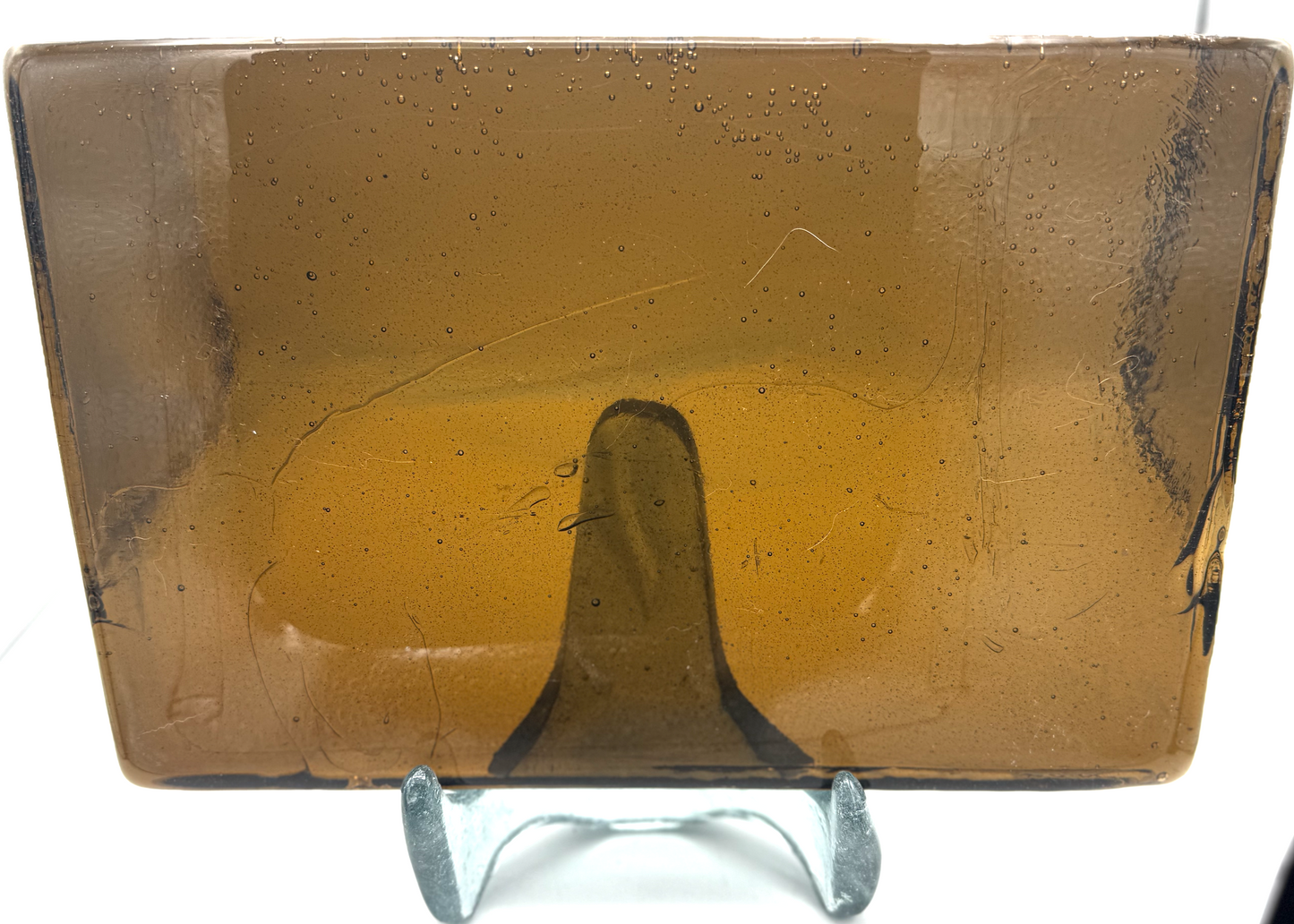
These dark gold Dalle de Verre slabs have a rich, warm character that shifts beautifully with the light. They appear to be transparent-to-translucent architectural cast glass, with deep golden amber, honey, and brown tones that become particularly luminous when backlit.
Visual character
-
Color: A deep antique-gold/amber palette, ranging from glowing honey and bronze near the illuminated areas to darker molten-gold and brown tones where the glass is thicker.
-
Light transmission: The slabs are strongly light-responsive. In direct or backlighting, the gold becomes remarkably radiant, while in reflected light the piece takes on a more subdued, earthy bronze appearance.
-
Surface: The interior has considerable visual texture—fine bubbles, tiny inclusions, subtle ripples, flowing striations, and areas of slightly different density. These characteristics give the glass an almost liquid or geological quality.
-
Edges: The edges appear substantially clearer and lighter, emphasizing the thickness of the slab and creating a natural luminous border.
-
Variation: The color isn't perfectly uniform, which is an advantage artistically. The variations create depth and prevent the slab from reading as a flat sheet of brown glass.
-
Organic marks: The elongated lines and irregular internal forms resemble currents, mineral veins, or movement frozen inside the glass. The small bubbles add another layer of visual interest.
The first photograph especially demonstrates the dramatic effect of strong backlighting: the upper portion glows almost like molten copper or a sunset, while the lower portion becomes a deep, sophisticated bronze-gold.
How an artist might use these slabs
1. Backlit wall sculpture
These would be exceptional as illuminated art. Mounting the slabs in front of concealed LED lighting would allow the gold to glow from within, revealing bubbles, ripples, and internal variations that are much less apparent under ordinary lighting.
2. Abstract architectural panels
A large composition could combine these dark-gold slabs with clear, amber, brown, or smoky Dalle de Verre pieces. The different densities would create a layered abstract landscape of gold, shadow, and transparency.
3. Sun-catching window or light installation
Placed near a window, the slabs could transform throughout the day. Morning and afternoon sunlight would produce different levels of golden transparency, while the internal texture would scatter and diffuse the incoming light.
4. Sculptural screens and partitions
Several slabs could be arranged with spaces between them to create a contemporary translucent screen. The dark gold would provide visual privacy while still allowing light to pass through.
5. Mosaic or cut-glass work
Because the slabs contain variations in color and density, an artist could cut them into smaller shapes and use the pieces as substantial focal elements in a Dalle de Verre mosaic. Cutting could expose different concentrations of gold and amber within the material.
6. Nature-inspired artwork
The coloration lends itself beautifully to themes such as autumn leaves, desert landscapes, sunsets, tree bark, amber, fire, and geological formations. The internal lines could become part of the imagery rather than being treated as imperfections.
7. Contrast with cooler colors
These slabs would be particularly powerful alongside cobalt blue, turquoise, cerulean, or green glass. The warm gold against cool blue-green glass could create a dramatic visual temperature contrast.
Overall artistic impression
I would describe these as deep golden-amber Dalle de Verre with bronze and honey undertones, possessing a distinctly molten, mineral-like presence. Their greatest strength is their relationship with light: they can appear dark and mysterious in reflected light, then become intensely luminous when illuminated from behind.
For an artist, they are especially valuable as focal pieces—glass that can provide warmth, depth, and a strong source of visual energy within a larger stained-glass, Dalle de Verre, kiln-formed, or mixed-media composition.