Like Breath on Glass
Blenko Dalle de Verre - Crystal Clear
Blenko Dalle de Verre - Crystal Clear
Couldn't load pickup availability
Share
These crystal-clear Blenko dalle de verre slabs reveal a quality that is often overlooked beside the drama of colored glass: light itself becomes the medium. Rather than contributing color, these slabs sculpt, bend, magnify, and animate light. Their exceptional clarity, combined with their substantial thickness, makes them as much optical objects as architectural glass.
Overall appearance
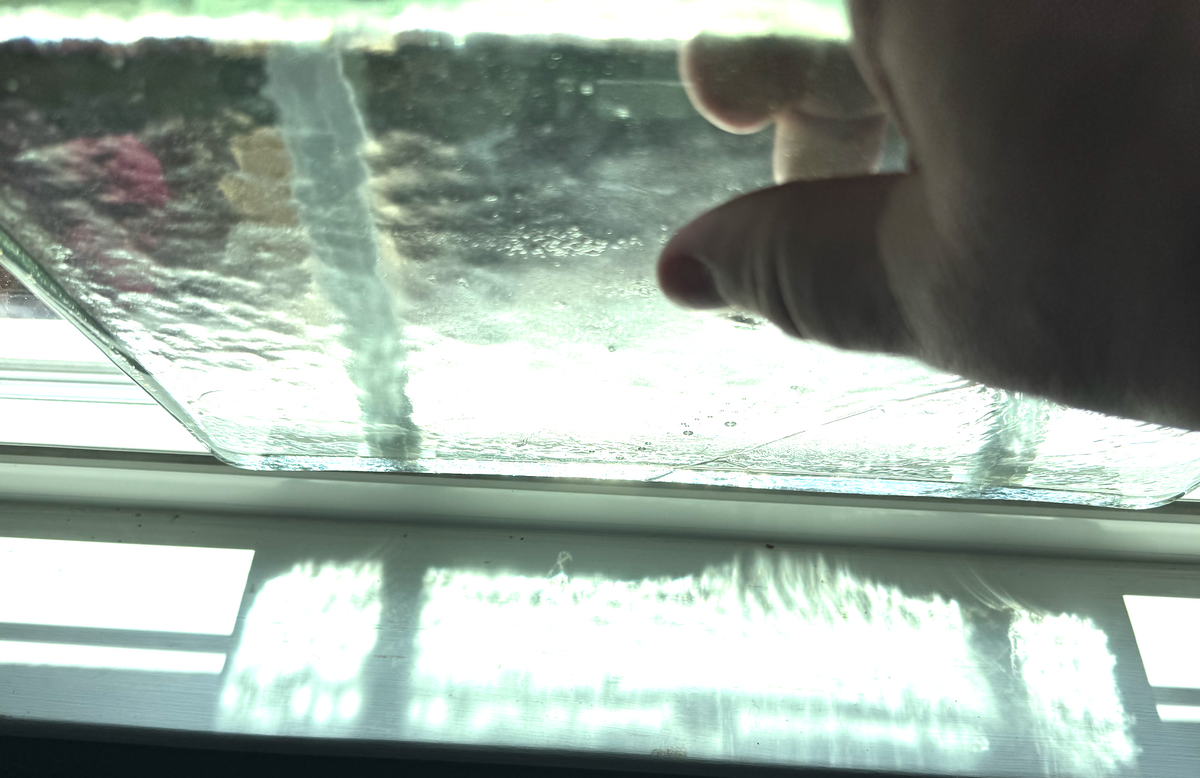
The slabs are essentially water-clear with a faint natural green cast, a characteristic of thick soda-lime glass caused by trace amounts of iron. In normal viewing the green tint is almost imperceptible, but along the thick edges it develops into a soft celadon glow.
Unlike float glass, these slabs possess the visual richness of hand-cast material. They feel less like windows and more like solid blocks of frozen water.
Optical character
What is immediately striking is their transparency.
Despite their considerable thickness, the slabs transmit an extraordinary amount of light while subtly altering everything seen through them.
Looking through the glass reveals:
-
gentle optical distortion,
-
wavering reflections,
-
soft magnification,
-
shifting focus,
-
and a remarkable sense of depth.
The surrounding landscape appears almost as though viewed beneath a quiet lake.
Light behavior
These photographs demonstrate perhaps the slabs' greatest strength.
Instead of simply transmitting daylight, the thick glass gathers and redistributes it.
Bright areas become:
-
luminous horizontal bands,
-
glowing edge highlights,
-
shimmering reflections,
-
and softly diffused pools of light.
The slabs behave almost like massive optical lenses.
Even without color, they create movement and atmosphere simply through refraction.
How an artist might use them
Light as sculpture
These slabs excel wherever the goal is to shape light rather than color it.
An artist might use them to create:
-
illuminated walls,
-
freestanding glass monoliths,
-
suspended architectural panels,
-
or minimalist installations where the changing daylight becomes the artwork.
Their appearance would transform continuously throughout the day.
Traditional dalle de verre
When broken into traditional faceted pieces, clear slabs become surprisingly expressive.
Each fractured surface acts like a tiny prism, producing:
-
brilliant highlights,
-
sparkling reflections,
-
internal mirrors,
-
and complex refractions.
Rather than disappearing, clear dalle de verre often becomes one of the most visually active elements in a composition.
Water and ice
Few materials represent water as convincingly.
Faceted clear slabs could evoke:
-
waterfalls,
-
glaciers,
-
breaking surf,
-
snow,
-
crystalline ice,
-
frozen rivers,
-
or rain.
The fractured edges would scatter light in a way remarkably similar to natural ice.
Highlights in stained glass
Clear dalle de verre serves as an ideal visual counterpoint to richly colored slabs.
Placed among cobalt, turquoise, emerald, ruby, or amber glass, it provides:
-
brilliant highlights,
-
visual breathing room,
-
reflections,
-
sparkle,
-
and areas where sunlight can remain nearly white.
Rather than interrupting the composition, it allows adjacent colors to appear even richer by contrast.
Contemporary architecture
Because of their neutrality, these slabs could be integrated into modern buildings as:
-
privacy screens,
-
daylight diffusers,
-
illuminated partitions,
-
staircase walls,
-
skylights,
-
or sculptural facades.
Their optical distortions preserve privacy while maintaining exceptional light transmission.
Combined with the colored slabs
Viewed alongside the cerulean, cobalt, and turquoise slabs, the clear glass becomes an essential part of a broader artistic palette.
It could represent:
-
sunlight breaking through water,
-
reflections on waves,
-
clouds,
-
crystalline highlights,
-
flowing rivers,
-
mist,
-
or simply spaces where light itself is allowed to dominate.
A composition transitioning from clear into turquoise, then cerulean, and finally cobalt would create a remarkably convincing illusion of increasing water depth, with the clear glass suggesting the sparkling surface and the deeper blues conveying the descent into open water.
Internal structure
The slabs contain numerous natural features that enrich rather than detract from their clarity.
Among them are:
-
tiny seed bubbles dispersed throughout the glass,
-
isolated larger air bubbles,
-
faint linear bubble trails,
-
slight density variations,
-
and occasional wispy inclusions formed during casting.
These suspended details give the slabs a quiet internal life. Rather than appearing perfectly industrial, they retain the unmistakable character of hand-cast architectural glass.
Artistic impression
These slabs possess a quiet elegance that rewards close observation. Their beauty lies not in vivid color but in their ability to reveal the architecture of light itself. The faint green edge glow, suspended bubbles, gentle casting ripples, and subtle optical distortions give them the character of naturally formed crystal or ancient ice rather than manufactured glass. In the hands of an artist, they become indispensable—not merely as transparent filler, but as active sculptural elements that catch, bend, and release light with extraordinary subtlety. Within a dalle de verre composition, they provide moments of luminosity and visual rest that heighten the brilliance of surrounding colors while contributing their own distinctive optical magic.