Like Breath on Glass
6 x 6 x 1/2 Inch Tile - Medium Lime Green
6 x 6 x 1/2 Inch Tile - Medium Lime Green
Couldn't load pickup availability
Share
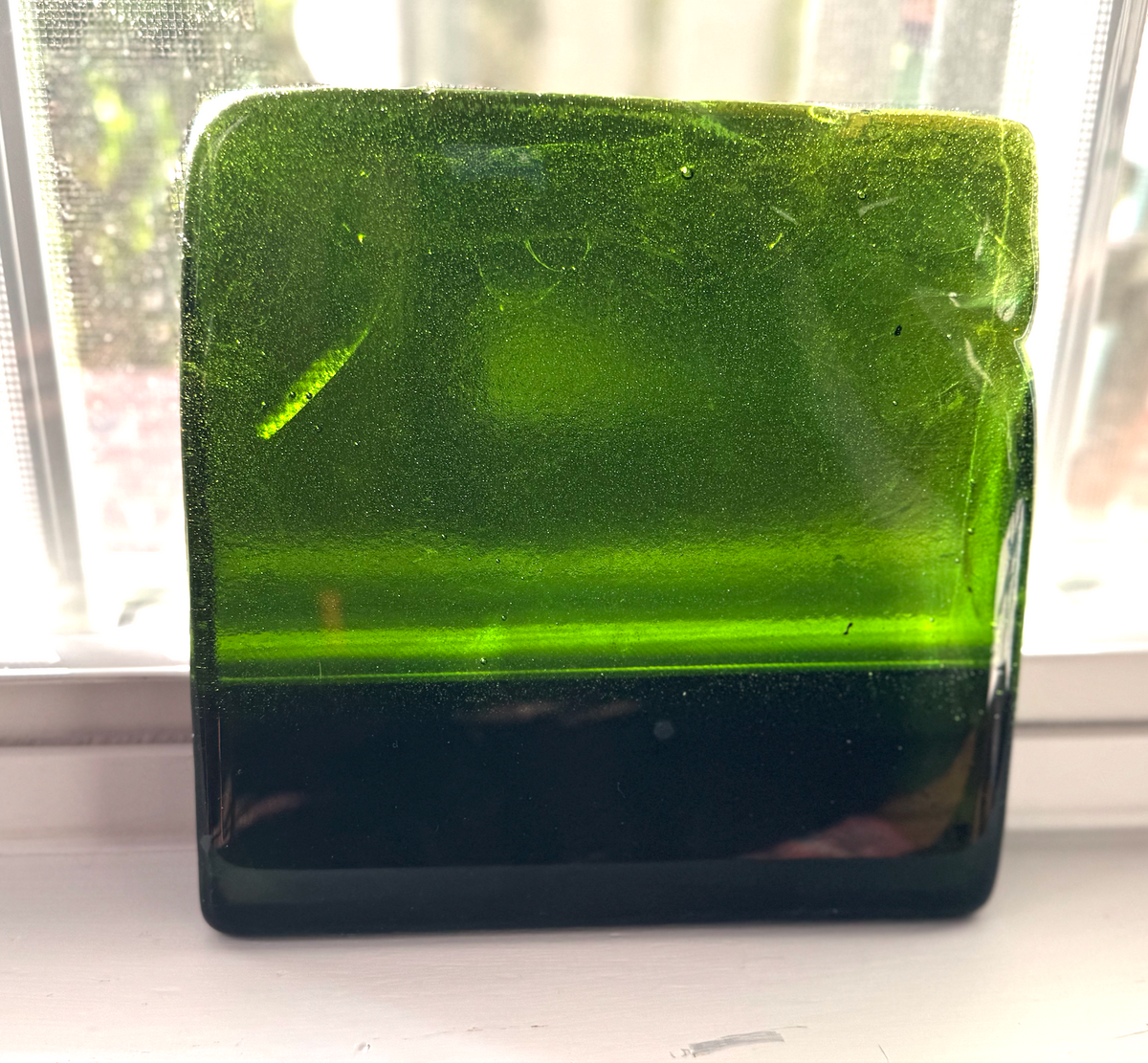
These 6 × 6-inch dark lime green kiln-formed glass tiles have a striking, luminous character. The color shifts dramatically with the lighting—from a deep, shadowy olive-green to an intense chartreuse/lime green when illuminated from behind. That color variation gives the glass considerable depth and makes it particularly attractive for sculptural and architectural artwork.
Artistic description
The dominant color is a rich dark lime green, with brilliant yellow-green highlights concentrated around the edges and in areas where light passes through more strongly. In transmitted light, the glass can become almost electric, glowing with a vivid acid-green luminosity. In reflected or lower light, it takes on a much deeper moss, olive, or bottle-green character.
Within the glass are beautiful flowing, organic variations. Broad translucent areas appear to sweep through the tile like currents, leaves, or layers of mineral. Subtle darker bands and wisps create movement across what is otherwise a strong, solid field of color.
The kiln-forming process has also produced distinctive internal characteristics:
-
Small bubbles and air inclusions are scattered throughout the glass, adding visual texture and sparkle.
-
Fine striations and directional marks create the impression of movement within the material.
-
Slightly cloudy and translucent passages contrast with clearer areas, producing depth.
-
The surfaces have a softly textured, almost satin-like quality in places rather than appearing completely optically smooth.
-
The edges are softly rounded from firing, giving the 6 × 6-inch pieces a substantial, finished presence.
-
When strongly backlit, the edges develop an especially beautiful neon-green glow.
How an artist could use them
These tiles would be exceptional as high-impact color elements in a glass composition. Their intense green makes them particularly useful as focal pieces rather than merely background color.
Botanical and nature-inspired work
The lime/olive palette naturally suggests leaves, vines, grasses, tropical foliage, moss, and aquatic vegetation. The internal flowing patterns could be incorporated into abstract representations of leaves or plant forms.
Water and landscape compositions
Placed alongside cobalt, turquoise, teal, or blue glass, the tiles could represent sunlit vegetation beneath water, shoreline grasses, or reflections. The green becomes especially dramatic when surrounded by cooler blues.
Abstract contemporary mosaics
An artist could cut or combine portions of the tiles with darker greens, yellows, blacks, and transparent glass to create a sophisticated abstract composition. The internal wisps provide visual movement without requiring additional decoration.
Backlit architectural art
This is perhaps one of their strongest applications. A light source behind the tiles would transform the dark green into a brilliant glowing lime/chartreuse. Used in a wall panel, window installation, light box, or sculptural screen, they could become almost jewel-like.
Stained-glass and architectural panels
Individual 6 × 6-inch pieces could serve as large color fields within a larger panel. Their substantial scale makes them useful for creating bold geometric sections rather than tiny mosaic details.
Sculptural glass work
The tiles could also be cut into organic shapes—leaves, petals, waves, geometric fragments, or irregular shards—and incorporated into a dimensional sculpture. Their thickness and internal inclusions would reward viewing from different angles.
Overall character
I would describe these as dramatic, luminous dark-lime kiln-formed glass with an olive-green depth and brilliant chartreuse transmission. They have a wonderful combination of strong color, organic internal movement, bubbles, subtle surface texture, and light-reactive transparency.
They would be especially compelling in artwork where the artist wants the green to glow rather than simply appear green. Against cobalt or deep blue glass, they could create an extraordinarily vibrant green-and-blue aquatic palette; against amber, yellow, or orange, they could produce a much warmer, almost tropical composition.