Like Breath on Glass
6 x 6 x 1/2 Inch Tile - Goldenrod
6 x 6 x 1/2 Inch Tile - Goldenrod
Couldn't load pickup availability
Share
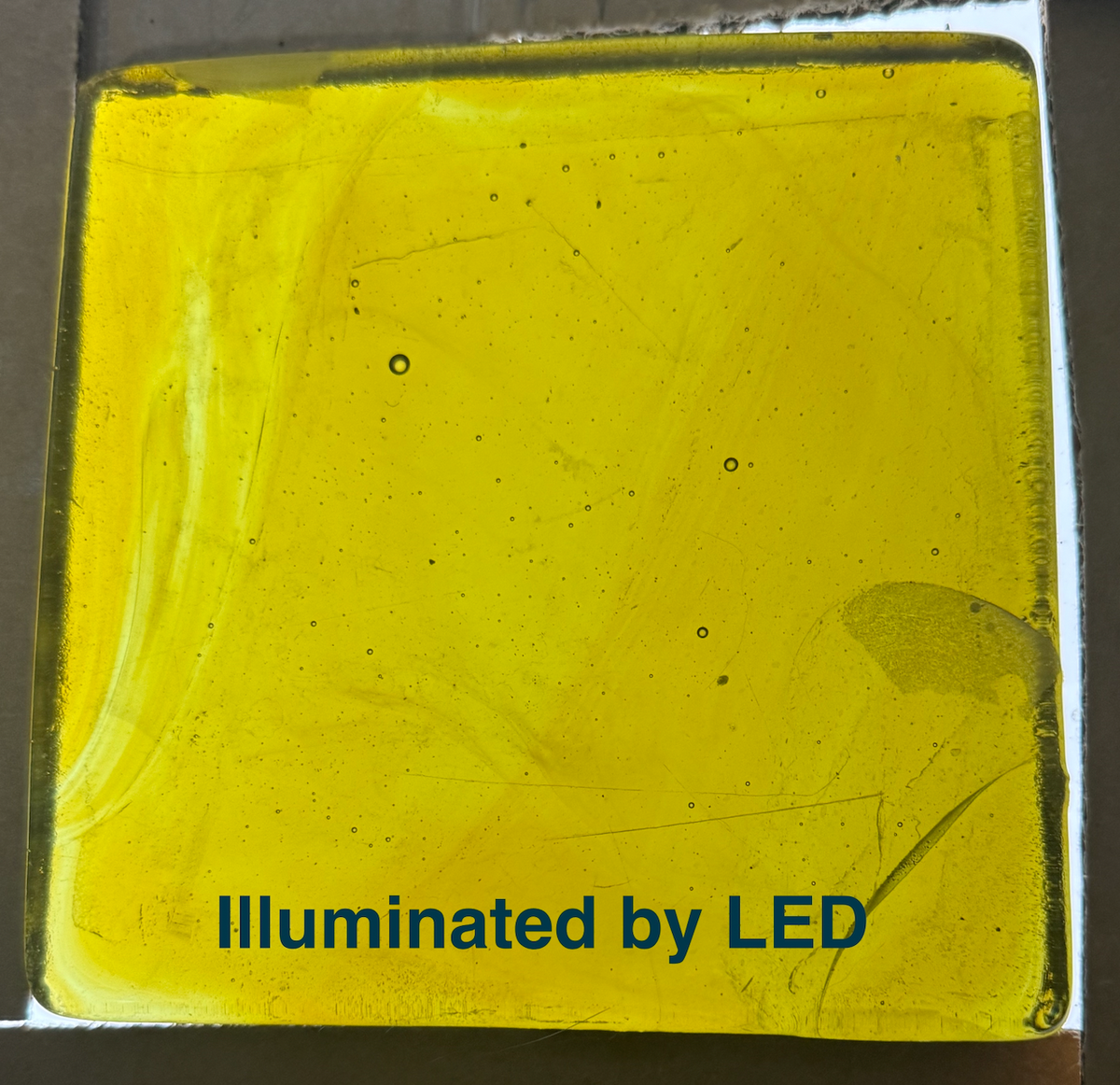
These 6 × 6-inch goldenrod yellow kiln-formed glass tiles have a rich, luminous character that changes dramatically with the lighting. In the photographs, they range from a deep golden-amber tone to an intense, almost sunlit yellow, particularly when illuminated from behind. The glass has considerable depth, giving the color a warm, dimensional quality rather than the appearance of a flat opaque yellow.
Visual character
-
Color: Rich goldenrod yellow, with variations toward honey, amber, and warm ochre.
-
Transparency: Translucent to semi-transparent, allowing light to travel through the body of the glass.
-
Surface: Smooth, softly glossy kiln-formed surface with subtle textural variations visible beneath it.
-
Internal character: Numerous tiny bubbles and fine linear marks give the glass an organic, handmade quality. These imperfections become especially noticeable when the tile is backlit.
-
Edges: Rounded, softened edges catch and concentrate light, creating a bright perimeter around the tile.
-
Light response: This is perhaps their strongest artistic feature. Natural sunlight or LED illumination can transform the yellow from a subdued golden tone into an intense glowing field of gold.
The tiles have a particularly beautiful jewel-like quality when illuminated from behind. The final photograph demonstrates how strongly the goldenrod responds to LED light, making the tile appear almost internally illuminated.
How an artist might use them
Sun and light compositions
Goldenrod is naturally suited to artwork exploring sunlight, warmth, and radiance. A large arrangement could become the central "sun" of an abstract glass panel, with blue, violet, red, or green tiles surrounding it.
Botanical and nature-inspired work
The warm yellow works beautifully for stylized flowers, autumn foliage, seed heads, grasses, and landscapes. Individual 6-inch squares could be cut or incorporated as larger graphic shapes within a botanical composition.
Abstract compositions
The tiles could represent fire, glowing embers, molten material, or reflected sunlight. Their transparency would allow overlapping pieces to create additional tonal depth.
Landscapes and sunsets
Goldenrod would be particularly effective alongside amber, orange, red, purple, and smoky glass. Used near a horizon, it could create the brilliant illuminated portion of a sunset while darker colors establish silhouettes or atmospheric depth.
Dramatic color contrasts
Pairing these yellow tiles with the lilac, violet, mahogany, or smoky topaz kiln-formed tiles you've shown would create an especially sophisticated palette. Purple and golden yellow are strong complements, so the combination could produce considerable visual energy.
Backlit architectural artwork
Because the color becomes dramatically more luminous with transmitted light, these tiles are excellent candidates for backlit wall panels, windows, light boxes, screens, and architectural glass installations. An LED source behind the glass could make the goldenrod appear to glow from within.
Mosaic and mixed-glass work
An artist could use the 6 × 6-inch tile as a substantial color block rather than treating it merely as a small mosaic tessera. It could be combined with smaller pieces of contrasting glass to create focal points, geometric patterns, or sweeping organic forms.
A particularly strong artistic application
I could envision these tiles forming the illuminated core of a contemporary glass panel: goldenrod yellow in the center, transitioning outward through amber and orange into mahogany or deep violet. With LED illumination behind the composition, the goldenrod pieces would become the visual "light source" of the artwork.
Overall, these tiles are less about simply adding yellow and more about adding light. Their combination of golden color, translucency, depth, bubbles, and kiln-formed surface variation gives an artist a material that can function as both color and illumination within a composition.