Like Breath on Glass
6 x 6 x 1/2 Inch Tile - Brite Green
6 x 6 x 1/2 Inch Tile - Brite Green
Couldn't load pickup availability
Share
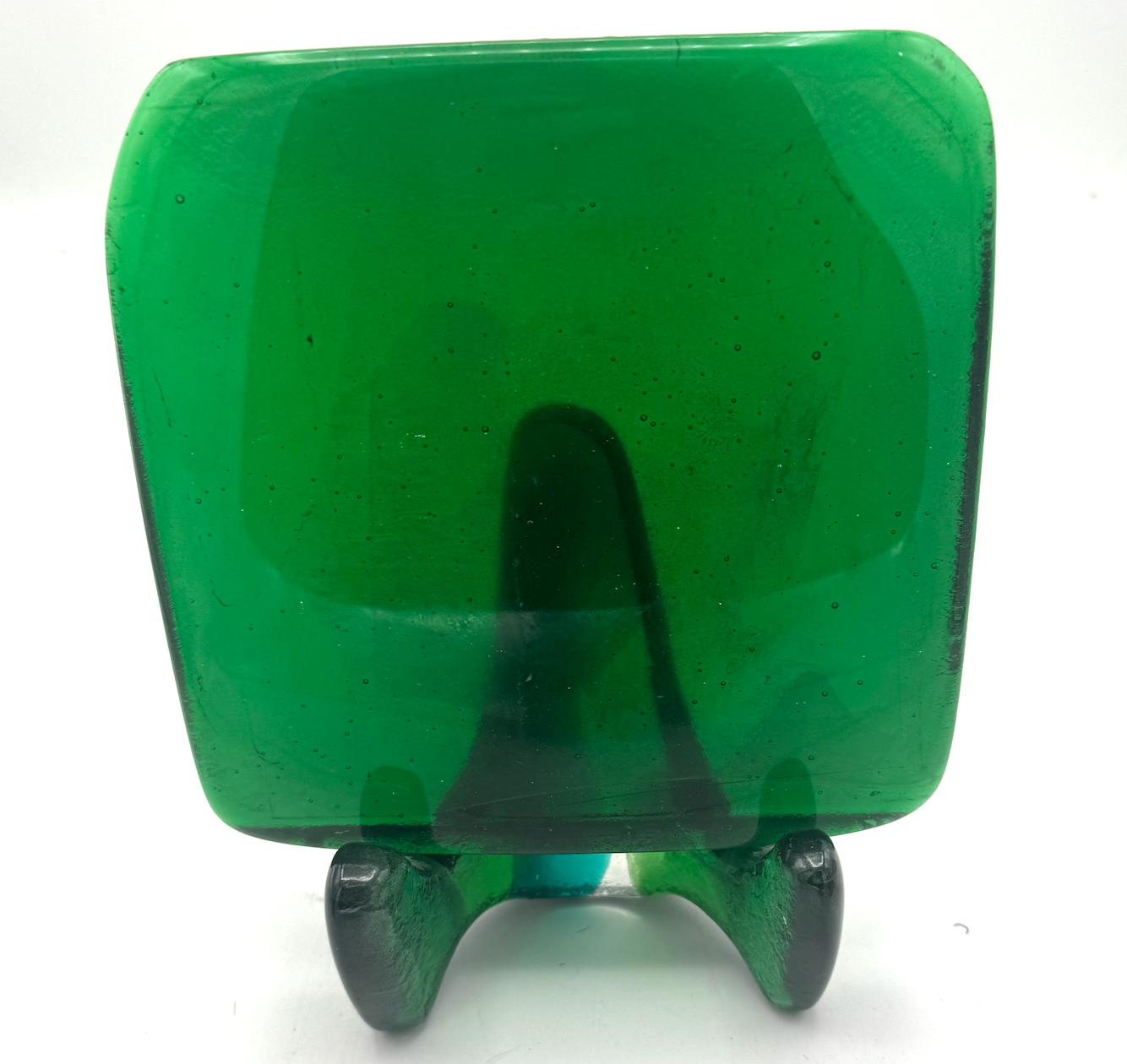
These tiles have a strong, saturated emerald-to-jade green presence that becomes especially dramatic when light passes through them. Rather than a flat opaque green, the glass appears translucent and luminous, with the color becoming deeper toward thicker areas and along the edges.
Visual character
-
Color: Vivid emerald, jade, and slightly blue-green tones, with intense green luminosity in transmitted light.
-
Transparency: Moderately to highly translucent. Backlighting produces a beautiful glowing green field, while reflected light makes the tile appear substantially darker and richer.
-
Surface: Softly textured and subtly uneven, with visible variations created during kiln forming. The surfaces contain numerous tiny air bubbles and internal irregularities, giving the glass a handcrafted character.
-
Edges: Rounded and softened from firing, with thicker edges that concentrate the green and create darker borders.
-
Depth: Particularly interesting because the green appears to have depth inside the glass rather than simply sitting on its surface.
-
Light response: One of the strongest qualities of these tiles. Sunlight or artificial illumination from behind can transform them from deep green panels into glowing jewel-like fields of emerald light.
The files are especially revealing: when viewed at an angle, the tile becomes almost sculptural, with the thickness, rounded perimeter, internal bubbles, and subtle variations in the glass becoming part of the artwork.
How an artist could use them
These 6 × 6-inch pieces would work exceptionally well as individual focal elements or as repeated modules in larger glass artwork.
1. Botanical and nature imagery
The saturated green is naturally suited to leaves, vines, forests, grasses, tropical foliage, and abstract botanical compositions. An artist could cut or combine the tiles with lighter greens and yellows to create layers of foliage.
2. Backlit wall sculpture
Mounting the tiles in front of an LED or natural-light source would exploit their translucency. Several tiles could be arranged with small gaps between them, creating a glowing emerald-green window or wall installation.
3. Water and landscape compositions
Despite being green, the cooler emerald character can work beautifully alongside cobalt, turquoise, cerulean, and clear glass. The artist could use the bright green for reflections, underwater vegetation, riverbanks, or abstract water landscapes.
4. Contemporary mosaic work
A 6 × 6 tile is large enough to function almost like a small painting. Multiple green tiles could be combined with contrasting colors—amber, gold, yellow, blue, turquoise, or clear glass—to create a contemporary mosaic with strong blocks of color.
5. Architectural glass panels
These would make striking components in a larger architectural composition. Alternating bright green tiles with clear or pale green pieces could create a rhythm of transparent and translucent areas.
6. Abstract sculpture
Because the glass has substantial visual depth, an artist could stack, overlap, or slightly offset pieces to create dimensional green forms. Layering the tiles would intensify the color and produce darker emerald regions.
Particularly strong color combinations
For a dramatic palette, I would pair these bright green tiles with:
-
Clear glass — emphasizes transparency and luminosity
-
Pale yellow/green — creates a springlike, botanical progression
-
Amber or dark gold — produces a rich complementary contrast
-
Turquoise — gives a tropical or underwater feeling
-
Cobalt or royal blue — creates a deep jewel-tone composition
-
Dark sea green — provides tonal depth while keeping the palette unified
Overall artistic character
I would describe these as bold, luminous, jewel-toned kiln-formed glass tiles. Their greatest strength is not simply the bright green color, but the way color, thickness, bubbles, surface texture, and transmitted light interact. They could serve as highly visible focal pieces in a mosaic, or become glowing individual "pixels" within a much larger architectural glass composition.
For an artist working in the style of Dalle de Verre or contemporary architectural glass, these would be particularly effective as the bright green highlights—the areas intended to catch the viewer's eye and glow when illuminated.